


Community Wildfire Protection Plans for the State of Hawaiʻi
19 Regions. Six Islands. One Mission: Wildfire Resilience.
The Community Wildfire Protection Plan (CWPP) is a vital tool for guiding communities, agencies, and stakeholders in reducing wildfire risks and enhancing resilience across our landscapes. Since its inception, the CWPP has provided a comprehensive foundation for understanding wildfire hazards, the characteristics of our landscapes, the values at risk, and the community and agency concerns that shape our wildfire mitigation strategies.
Explore the Islands
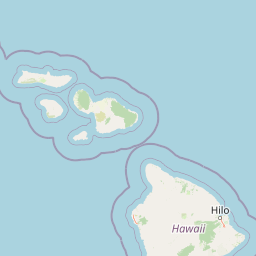
19 CWPP Regions Across Hawaiʻi
Click any marker to navigate to that region's wildfire protection plan details.










CWPP Status
- Current (Completed)
- In Process
Statewide
Why Wildfire Protection Planning?
"Unlike the contiguous United States, wildfire is not a natural part of Hawaiʻi's ecosystem."
Unlike the contiguous United States, wildfire is not a natural part of Hawaiʻi's ecosystem. In Hawaiʻi, wildfires destroy native ecosystems, which impacts watersheds and traditional cultural activities. Wildfires have also caused the demise of or have fragmented the habitats that support native flora and fauna, many of which are listed as endangered or threatened. Sixty-five percent (65%) of Hawaiʻi Island's dryland forest ecosystems have been lost primarily due to wildfire carried by invasive grasses. Consequently, Hawaiʻi's dryland habitats are mere remnants of what was once referred to as the most diverse dryland ecosystem in the state. Wildfires in Hawaiʻi also cause soil erosion, which negatively impacts our ocean reefs. The overwhelming majority of wildfires in Hawaii are caused by arson or human error. Wildfires in Hawaiʻi are a mauka to makai issue — what burns in the uplands reaches down to the coast, threatening the safety of our communities, the health of our watersheds, and the resilience of our natural and cultural resources. Uncontrolled fire endangers people and the homes they live in, placing families and entire neighborhoods at risk while straining the fire departments and emergency responders who protect them. It also damages the lands and resources that sustain us — grazing lands, forests, sacred sites, and the places that carry cultural meaning and identity across generations. HWMO works alongside ranchers, cultural practitioners, fire departments, landowners, and other local partners to reduce the number of wildfires and lower wildfire risk for communities and the precious natural resources throughout the State of Hawaiʻi, recognizing that protecting our people, our homes, and our ʻāina is a shared responsibility.
65% of Hawaiʻi Island's dryland forest ecosystems lost primarily due to wildfire
Wildfires destroy native ecosystems, impacting watersheds and cultural activities
Habitats supporting endangered flora and fauna fragmented by fire
Majority of wildfires caused by arson or human error
Statewide
The Purpose of Wildfire Protection Planning
"Motivating communities toward fire-adapted resilience"
The purpose of wildfire protection planning is to motivate and empower local government, communities, and property owners to organize, plan, and take action on issues impacting the safety and resilience of values at risk. It aims to enhance levels of fire resilience and protection to the communities and infrastructure, identify the threat of wildland fires in the area, identify strategies to reduce the risks to structures, infrastructure, and commerce in the community during a wildfire, identify wildfire hazards, education, and mitigation actions needed to reduce risk, and transfer practical knowledge through collaboration between stakeholders toward common goals and objectives.

Fire Adapted Communities
Resilient Landscapes
Safe & Effective Wildfire Response
Drivers of Risk
Understanding Wildfire in Hawaiʻi
The CWPPs across all islands converge on three interconnected themes that shape wildfire risk statewide.
Hawaiʻi's Fire-Prone Climate
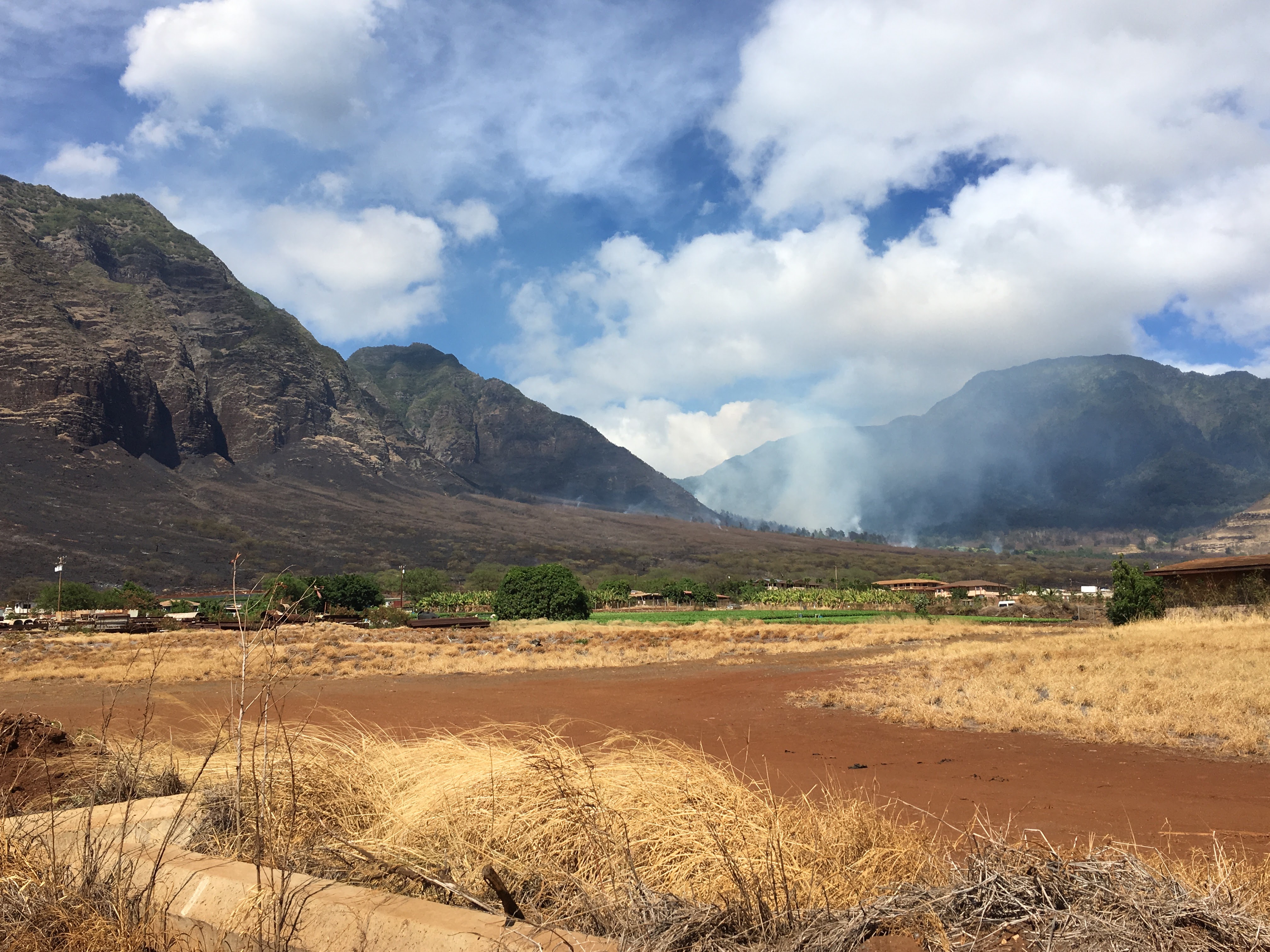
Hawaiʻi's fire risk is fundamentally shaped by climate. The state experiences a distinct dry season (May–October) driven by the North Pacific High, which suppresses rainfall and fans strong trade winds. During El Niño years, drought conditions intensify statewide. The leeward sides of all islands—where the majority of CWPP planning areas are located—receive less than 20 inches of rain per year, creating bone-dry fuel conditions that persist for months. Foehn-effect winds, known locally as Kona winds, bring hot, dry, downslope airflow that dramatically elevates fire danger within hours.
Photo Gallery


Key Findings Across All Regions
Dry season runs May–October, coinciding with peak fire activity
Leeward zones receive fewer than 20 inches of annual rainfall
El Niño events intensify drought and extend the fire season
Kona winds deliver hot, dry, downslope conditions that accelerate fire spread
Trade wind inversions trap smoke and increase health hazards for coastal communities
Source Documents
Access the Full CWPP Plans
Download or view the complete Community Wildfire Protection Plan documents for each region.
Kaʻū CWPP
Hawaiʻi Island
Northwest Hawaiʻi CWPP
Hawaiʻi Island
Hāmākua CWPP
Hawaiʻi Island
North Kona CWPP
Hawaiʻi Island
South Kona CWPP
Hawaiʻi Island
Upcountry Maui CWPP
Maui
Leeward Haleakalā CWPP
Maui
South Maui CWPP
Maui
Western Maui CWPP
Maui
North Shore Oʻahu CWPP
Oʻahu
East Honolulu CWPP
Oʻahu
Western Oʻahu CWPP
Oʻahu
Kauaʻi CWPP
Kauaʻi
Molokaʻi CWPP
Molokaʻi
Hawaiʻi Wildfire Management Organization